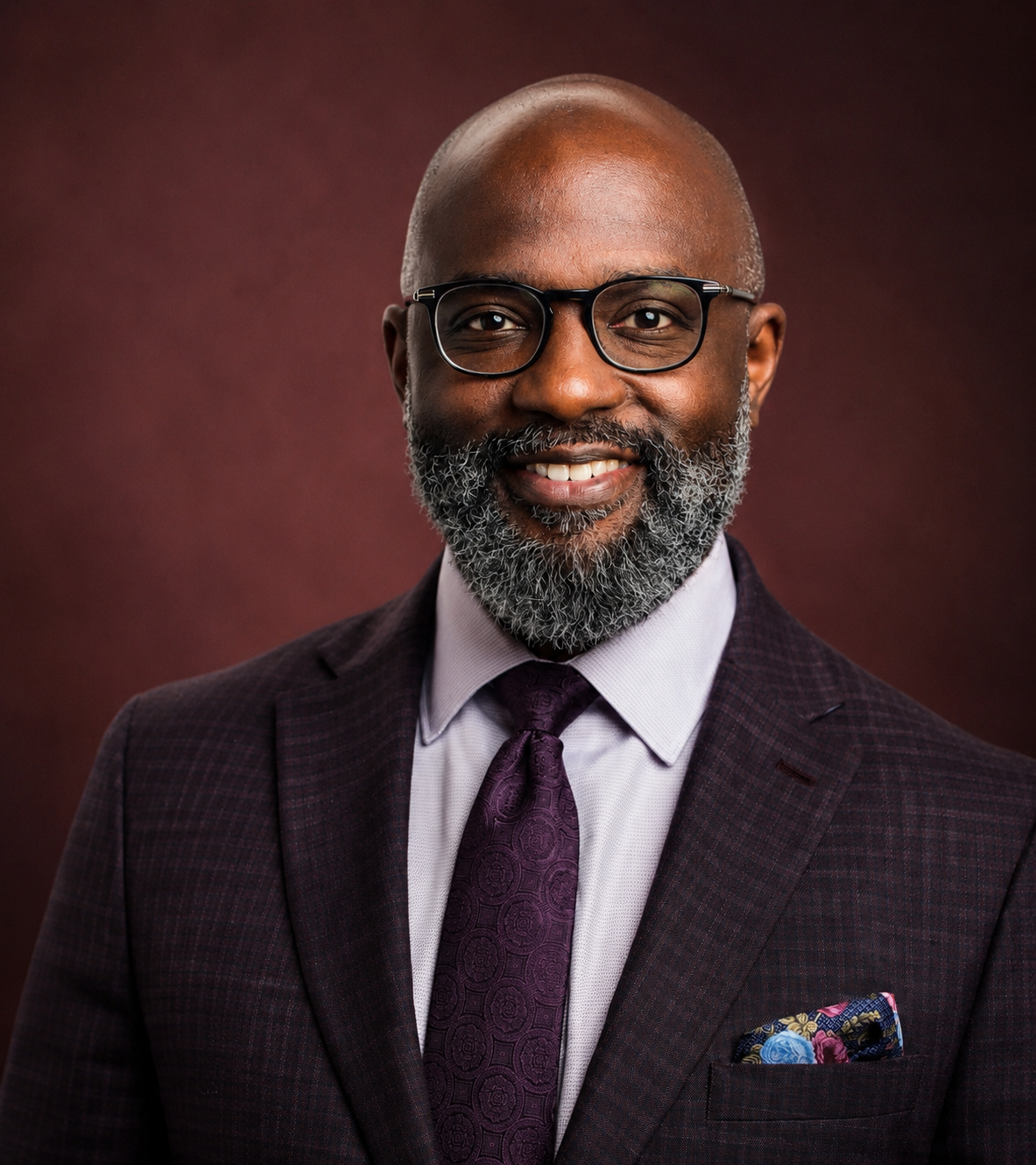
About Jeffrey
I am an educator who has spent twenty-seven years trying to answer one question: what does it actually take to help a person think well?
The question is not abstract for me. I have asked it as a classroom teacher who watched students arrive without the habits of mind their futures would require. I have asked it as a school leader trying to build cultures where teaching could become formation rather than delivery. I have asked it as a community college dean, working across a seven-campus system on the practices that make educators stronger and students more capable. The question has followed me through every role, and the answers have changed in ways I did not expect when I started.
This page is the longer version of how I came to the work, what I have learned along the way, and what I am trying to do now.
How I came to this work
I grew up believing that education could change a life, because it had changed mine. Some of my earliest memories are of sitting in classrooms where the teachers were not simply delivering lessons. They were teaching me how to ask questions, how to weigh what I was hearing, and how to imagine a future larger than the one I could see from where I was standing.
I did not have the language for it at the time, but what those teachers were doing was formation. They were shaping the way I thought before they were shaping what I knew. The distinction has stayed with me for forty years, and it is the foundation of nearly everything I have written, taught, or led since.
When I became a teacher myself, I learned what every honest teacher eventually learns. Students remember almost nothing of what we say and almost everything of how we made them feel. They remember whether you believed in them, whether you saw them, whether your classroom was a place where their thinking was taken seriously. That was the second lesson, and it changed how I have approached every subsequent role.
The arc of the career
The classroom taught me what teaching actually requires, which turned out to be different from what I had been trained to do. The training prepared me to deliver content. The work asked me to form people. I spent the first several years of my career closing that gap, and the closing of it shaped everything that came after.
School leadership taught me that the conditions for good teaching are mostly institutional. A teacher can be excellent and still be defeated by a master schedule, a misaligned evaluation system, or a culture that rewards compliance over thought. Leadership, properly understood, is the work of building the conditions under which formation can actually happen. I learned that work slowly, often by doing it badly first.
Higher education taught me the scale of the problem. The students arriving at the community college were carrying the consequences of every decision the K–12 system had made about them. Some of those decisions had been generous and some had not, but all of them had compounded by the time the students reached me. The question shifted from how to teach well in a single classroom to how to design institutional structures that take responsibility for the formation of adults who have already been taught that thinking is not their job.
I now serve as Dean of Student and Faculty Empowerment in the School of Education at Dallas College, where the question is operational every day. We are preparing future educators in one of the largest community college systems in the country, and the decisions we make about how we teach them will shape how they teach the children who arrive in their classrooms a decade from now. It is the most consequential work I have done, and it is the reason I have started to write more publicly about what I have come to believe.
What I am working on now
The institutional work continues. At Dallas College I oversee academic and student affairs across the School of Education, with responsibilities spanning enrollment and retention, accreditation, K–12 partnerships, and the long project of building programs that take the formation of educators seriously. The work is unglamorous in the way that institutional work always is, and it is the work I most want to be doing.
Alongside the institutional work, I write at Deep Thinker Lab, a Substack publication where I think out loud about thinking, leadership, culture, and the future of learning. The publication is where I work through the questions that the day job raises but cannot fully answer. It is also where readers who want to follow my thinking over time will find the most complete record of it.
In June 2026 I will publish Mastering the Mind: A Guide to Improving Your Critical Thinking, which is the most operational statement I have written of what it takes to develop reasoning as a discipline. A second book, Think Like an Educator, follows in 2027 and turns the same question toward the people whose vocation is the formation of others. I have been writing toward both books for most of my career, and they represent the public expression of work I have been doing privately for years.
I also host the Purpose Driven Educator Podcast, where I talk with people doing the slow, hopeful work of shaping the next generation. The conversations have shaped my own thinking as much as anything I have written.
The record
For readers who want the conventional version of the credentials, here it is in brief.
I hold an Ed.D. in Curriculum and Instruction from Texas A&M University and have served in roles spanning K–12 instruction, building and district leadership, and community college administration. I am currently in the second year of a four-year Trustee term with the College Board, and I serve on the Community College Advisory Panel, which advises the College Board on issues affecting two-year institutions. I serve as a Peer Reviewer for the TABSE Research Journal and as a member of the Dallas College Speakers Bureau. I have spoken at conferences, contributed to grant-funded initiatives on AI fluency for educators, and led institutional projects ranging from dual credit research to the support of pre-apprenticeship programs.
The credentials are real, and they matter, but they are not the point. They are the result of trying to do the work seriously over a long enough period that the work eventually produced them. If they are useful to you in deciding whether to take my writing seriously, take them seriously. If they are not, the writing will have to make its own case.
A closing note
Outside the work, I have a family that has shaped my thinking about formation more than any institution I have served. They are the reason I take the long view of this work, and the reason I believe that what happens in classrooms matters far beyond the classroom.
That is the work. The rest will have to argue for itself.