Creativity Matters, Right?
Today’s demand for a highly skilled workforce in the areas of science, technology engineering, and math (STEM) is making an immediate impact on our society and what we value in education. Changes in state and federal budgets further illustrate this shift our society is making in educational priorities. I am starting to wonder what will be the long-term effects of these changes.
Today’s demand for a highly skilled workforce in the areas of science, technology engineering, and math (STEM) is making an immediate impact on our society and what we value in education. Changes in state and federal budgets further illustrate this shift our society is making in educational priorities. I am starting to wonder what will be the long-term effects of these changes. How will they impact our society’s ability to create, innovate, communicate, or simply express the qualities that truly make us human? Don’t get me wrong, as a Physics educator, I am all for the investment in STEM. I would just like to see more emphasis on the value and versatility in cultivating one’s creativity.

Source: edtechmagazine.com via Textbooks.com on Pinterest
Why should blended learning be expanded?
There are many different blended learning models today, but what is at the heart of blended learning? According to the Innosight Institute,
blended learning is a formal education program in which a student learns at least in part through online delivery of content and instruction with some element of student control over time, place, path, and/or pace and least in part at a supervised brick-and-mortar location away from home.

macbook pro
There are many different blended learning models today, but what is at the heart of blended learning? According to the Innosight Institute,
blended learning is a formal education program in which a student learns at least in part through online delivery of content and instruction with some element of student control over time, place, path, and/or pace and least in part at a supervised brick-and-mortar location away from home.
At first glance, this definition sounds very technical, but at the heart of this definition is a situation in which students are engaged in a realistic learning environment for today’s expectations. This becomes more clear when we consider the needs of the 21st-century learner as well as the deficiencies of the 21st-century American workforce. Both unveil the misalignment between our current educational practices and our desired outcomes.As a district administrator, one of my tasks is to coordinate the development of a college-going culture. This includes but is not limited to:
Helping teachers better understand their students’ needs
Helping students to become better learners
Incorporating the skills sets that are increasingly necessary for today's workforce (21st-century skills)
This is where blended learning models come in. These are not silver bullets, but they are ways to better serve students on silver platters. The teachers today are confronted with many obstacles, but blended learning affords them with models to address today’s college and career demands. If we are truly working to prepare students for the rigors of college and career, we have to be focused on how students learn, the learning environment, and the expectations after they leave the K-12 system. If done well, blended learning accomplishes these goals.There are several key factors that should be addressed before considering an implementation of a blended learning model, all of which are rooted in proper planning and support. These key indicators are presented clearly in the infographic found below from Digital Learning Now.
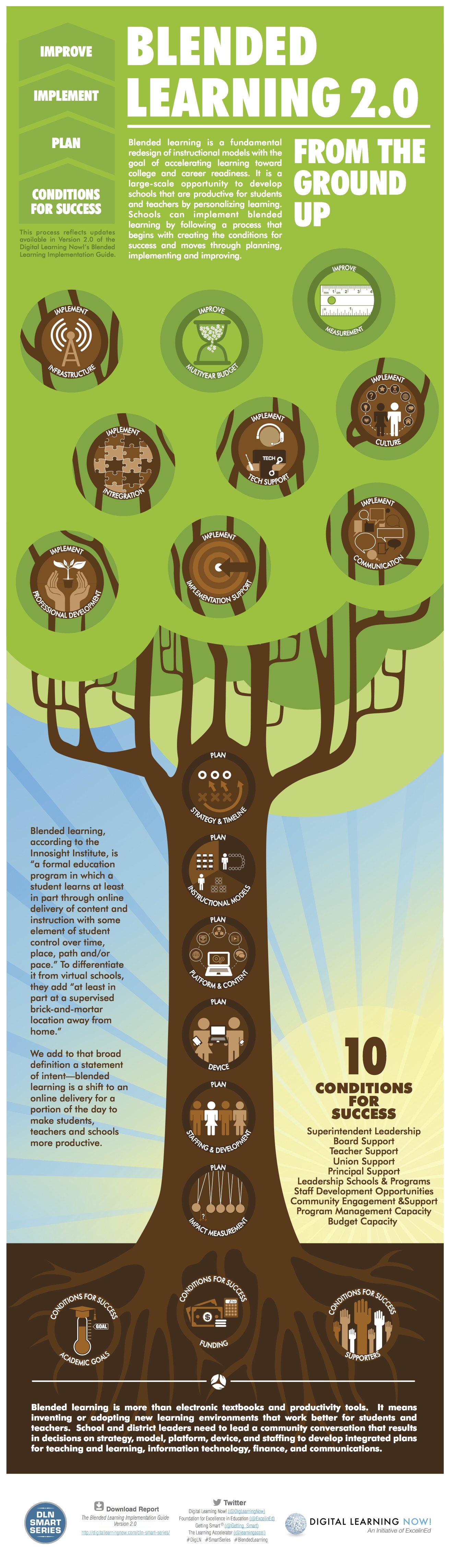
blended-learning
Exposing K-12 Schools Achilles' Heel
One of the most prominent issues that affect K-12 public schools as social organizations is a propensity to operate from the position that "We're going to do what we've always done because that's what we've always done." This notion is pervasive and widely unrecognized and acknowledged. Likewise, the habits that arise from this notion are formed subtly yet become deeply ingrained in (and debilitating to) the system operations. Practically speaking, systems tend to employ practices or habits that are undocumented in policy, unsupported by data and are not effectively educating students. The negative consequences of this mindset include parents withdraw their students in favor of the more flexible and responsive systems of private and charter schools; educators' efforts are constrained and academic performance is weak; the best and most innovative educators are recruited by other systems or possibly even leave the field; and students suffer because they are not prepared to meet the demands of an ever-changing society. Left unchecked, poor organizational habits within systems ultimately weaken our nation's ability to compete on the global level.

090720_Tweens
One of the most prominent issues that affect K-12 public schools as social organizations is a propensity to operate from the position that "We're going to do what we've always done because that's what we've always done." This notion is pervasive and widely unrecognized and acknowledged. Likewise, the habits that arise from this notion are formed subtly yet become deeply ingrained in (and debilitating to) the system operations. Practically speaking, systems tend to employ practices or habits that are undocumented in policy, unsupported by data and are not effectively educating students. The negative consequences of this mindset include parents withdraw their students in favor of the more flexible and responsive systems of private and charter schools; educators' efforts are constrained and academic performance is weak; the best and most innovative educators are recruited by other systems or possibly even leave the field; and students suffer because they are not prepared to meet the demands of an ever-changing society. Left unchecked, poor organizational habits within systems ultimately weaken our nation's ability to compete on the global level.
To address this issue, organizations should establish habits of reflection at the teacher and administrator levels so they can begin to make the connections between practices and outcomes more real or direct. Examples of these habits include coaching conversations between teachers and teacher leaders; feedback shared by teachers in professional learning communities; and collaborative administrators dialoguing about effective practices. Creating opportunities for reflection not only helps teachers and administrators, but it also promotes an environment and culture in which all stakeholders can challenge organizational habits. In addition to reflection, schools should re-evaluate policies to determine if they are being followed and if they are in support of their short-term and long-term goals. The only thing worse than a bad policy is a good policy that is not followed; nevertheless, both allow schools the continue practicing bad habits. Schools also need to review what is policy and what are actual practices in order to expose unwritten organizational habits. This involves questioning a policy's clarity and usefulness, evaluating desired outcomes using research and measurement tools, and working to redefine policies based on their findings. Lastly, K-12 public schools should establish protocols for using data to make decisions, set goals, and evaluate programs or outcome. This process should address the questions, "What do we do with the data we receive", "What questions do you ask", and "What data sets are most relevant?" Far too often K-12 schools are data rich but information poor; school systems must reach the point where they see the issues clearly and are able to mobilize resources to implement real solutions.
K-12 schools are charged today with the task of educating a quickly changing student body to face the challenges of a dynamic workforce and society. If schools implemented these practical solutions with fidelity, not only will they be able to finally dismantle the debilitating organizational habits that plague them, they will be able to change in the appropriate time frame necessary to respond to the needs of today's student.