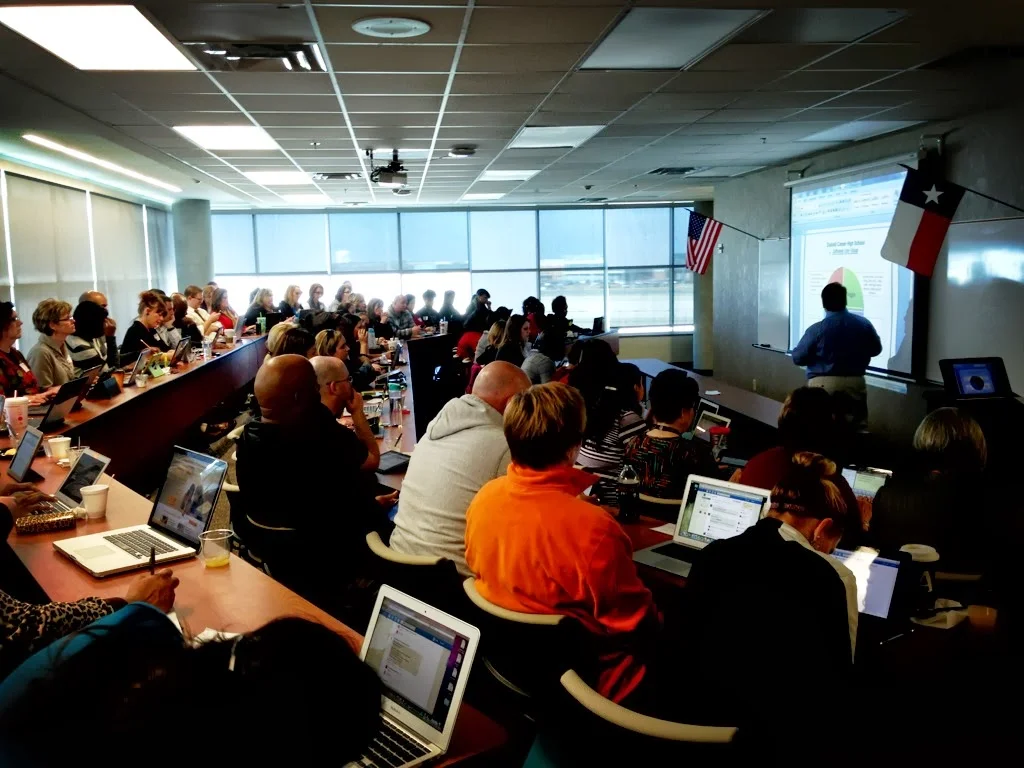
What is your 21st Century Professional Development Plan?
The increasingly competitive global workforce of the 21st century has brought on the need for students and teachers to develop new skills and competencies in our educational systems. Given that the 21st-century classroom is characterized by innovation and project-based context, schools should adopt a 21st-century teaching and learning methods that blend creative thinking skills and employs methods of instruction that integrate modern learning technologies and real-world contexts (Wan & Gut, 2011).

Teacher PD
The increasingly competitive global workforce of the 21st century has brought on the need for students and teachers to develop new skills and competencies in our educational systems. Given that the 21st-century classroom is characterized by innovation and project-based context, schools should adopt a 21st-century teaching and learning methods that blend creative thinking skills and employs methods of instruction that integrate modern learning technologies and real-world contexts (Wan & Gut, 2011). To this end, educators need to be prepared to serve students in the context of new expectations to meet the demands for a more skilled workforce. Accordingly, professional development training for teachers should incorporate innovative curriculum that includes modern technology skills, and practical experiences in a 21st-century classroom environment. This suggests that teachers should also learn about innovative curricula that incorporate critical thinking, complex problem solving, creativity and entrepreneurial thinking, communication and collaboration, innovative use of knowledge, and financial literacy.
How are you personally preparing to address your student’s need to develop 21st-century skills? What is your district’s plan to address these increasing demand for change? At this point, every school system should have educators and administrators actively participating in on-going professional development that focuses on building the capacity of district-level leadership teams, principals, and teacher leaders in understanding 21st-century skills and their importance. According to Wan & Gut (2011), every aspect of our education system including professional development must be aligned to prepare students with the 21st-century skills. Not only should this professional development instruct educators on the 21st-century skills, it should also incorporate modern ideas around technology, innovative pedagogies, and new understandings of the nature of 21st-century students. More specifically, the professional development activities should challenge new and veteran teachers to work within more significant teaching teams and more collaborative professional learning practices (Campbell, Saltmarsh, Chapman, Drew 2013).

ubiquitous technology
Teachers of 21st-century students are increasingly experiencing classrooms where the availability and use of technology by students is ubiquitous. Educational researchers assert,
… it can be argued that there is a need within education for the greater incorporation of technology, a reinvention of the way that classrooms and schools are constructed (at both the physical and relational levels) that respond to the necessary 21st-century skills. The changing nature of technology (moving from static tools for information delivery to dynamic, user developed tools of co-creation and sharing) provides a hint as to what these 21st-century skills may be (Campbell, et.al, 2013, pg. 211).
Along with the integration of technology, 21st-century classrooms are deeply rooted in innovation and problems solving (Chesbro & Boxler 2010). This change in the learning environment for teachers and students creates a need for schools to become responsive and implement new pedagogies to that go beyond the traditional classroom pedagogy (Campbell, et.al, 2013). This is also supported by Wan & Gut (2011),
“For in-service teachers, “just-in-time” preparation that includes coaching and identification of new pedagogical tools and approaches to weave 21st century skills into content areas should be made available. Ideally, teaching academies, or other special initiatives, should exist so teachers can develop and renew 21st century skills and pedagogy in structured programs” (Wan & Gut, 2011, pg. 167).
It is difficult for teachers to teach what they have not experienced or do not know. To this end, the professional development for veteran teachers should intentionally be crafted to ensure the development 21st-century skills in collaborative non-traditional environments to help them understand the needs of the 21st center learner (Wan & Gut, 2011). The closer the professional development environments are to the student learning environments, the more the sharing of practices will lead to the enhancement of student learning (Campbell, et.al, 2013).To summarize, the on-going professional development for veteran teachers should include activities that incorporate innovative uses of technology, pedagogy training that is designed for the 21st-century classroom, and opportunities for teachers to work in collaborative teams of teachers to foster the teacher development of 21st-century skills and competencies.
References
Campbell, M., Saltmarsh, S., Chapman, A., & Drew, C. (2013). Issues of teacher professional learning within ‘non-traditional’ classroom environments. Improving Schools, 16(3), 209-222.
Chesbro, P., & Boxler, N. (2010). WEAVING THE FABRIC of professional development in the 21st century through technology. Journal of Staff Development, 31(1), 48-53,70. Retrieved from http://lib-ezproxy.tamu.edu:2048/login?url=http://search.proquest.com/docview/870739723?accountid=7082
Wan, G. & Gut, D.M. (2011 ) Explorations of Educational Purpose, Bringing Schools into the 21st Century [iBooks Edition]. Retrieved from iTunes.

Learning anything this summer?

sandy_island_caribbean-normal
Summer is in full effect. Swimming, family trips, and other leisure activities are also in full effect. As a result, I am sure that professional learning is not ranked very high on the summer fun list for most teachers. The funny thing is the summer presents the most optimal time for exploring very meaningful professional development ideas. I have come to understand the value of the of a well-timed summer professional learning task, and I would like to solicit other educators for their ideas for teachers of various levels of experience. Please comment below with a professional learning idea that you have benefited from and would like to share with others.
Implementing Traffic Light Reflection

educator
In a world of ever-increasing productivity, it is easy to feel the pressure to do more. I know many educators, including myself, have been forced to learn how to do more with less in this down economy and diminishing education budgets. I, in fact, have been reflecting more on my current realities and have been trying out different strategies for increasing my teachers' effectiveness. So far one of the most effective strategies has been helping teachers establish and follow through with a traffic light reflection. If you work in a coaching role with teachers, try these three strategies for helping increase teacher effectiveness.
1. Examine your practice. When I work with educators, I constantly try to help them make connections between their efforts and their desired results. Well, that involves two important steps: understand clearly what you are trying to achieve and recognize the actions you are taking to accomplish your goals. I believe it is essential that a coach have clarity in both before successfully helping an educator reach his goals. Basic questions like, what evidence should you see to inform you that you are reaching your goals, what would success look like for you, or what moves have you made as a result of these on to the next challenge, should become a regular part of a teacher's reflection and should be answered with clear measurable steps or actions for the coach.
2.Red Light, Yellow Light, Green Light. In everything a coach should strive to help a teacher take a structured approach toward reflection. As I mentioned earlier, it is easy to get into the routine of adding on more things to do or taking on more responsibilities. In my work I have found that more attention should be given to identifying the actions that are contributing to the goal as well as those that are not contributing. To do this I recommend using what I call a traffic light approach to reviewing action. If followed one should look at the actions that should be started - the "green light", the actions that should be continued - the "yellow light", as well as the actions that should be stopped - the "red light". I have personally found it easier to find the green and yellow light tasks that should be added or continued, while the red light tasks that need to be discontinued are sometimes less obvious.
3. Take a 30 day challenge. This step is simple. Now that you have clearly articulated the end goal and have applied a traffic light reflection to your actions, make a concerted effort to keep track of your efforts for 30 days. I have found that making this short-term goal allows you to ease into the new reflection habit while giving you enough time to measure a change in your effectiveness. With a new year right around the corner this could be a perfect fit.