More STAAR Tests, Less Teaching & Learning
oday, May 6, 2019, the Texas legislators are slated to vote on a version of the school finance legislation, House Bill 3, that includes a proposal to add four more writing tests and tie school funding directly to third-grade STAAR results. The new exams would bring the total number of annual assessments to 21 and would mark the second change to the number of tests since 2012. Currently, the State of Texas Assessments of Academic Readiness (STAAR) includes the following assessments:

Today, May 6, 2019, the Texas legislators are slated to vote on a version of the school finance legislation, House Bill 3, that includes a proposal to add four more writing tests and tie school funding directly to third-grade STAAR results. The new exams would bring the total number of annual assessments to 21 and would mark the second change to the number of tests since 2012. Currently, the State of Texas Assessments of Academic Readiness (STAAR) includes the following assessments:
Reading and Mathematics, grades 3–8;
Writing at grades 4 and 7;
Science at grades 5 and 8;
Social Studies at grade 8;
End-of-Course (EOC) assessments for English I, English II, Algebra I, Biology and U.S History; and
Optional End-of-Course (EOC) assessments for English III and Algebra II.
According to a Texas Monthly article published this weekend, the last-minute tinkering of the recently proposed and significant school finance House Bill 3 to include more STAAR exams and link funding to third-grade STAAR results, by the Senate Education Committee comes at a time when many critics are questioning the accuracy and efficacy of the STAAR exams. Many proponents point to the need to increase the numbers assessments in order to determine student academic progress better. Moreover, the focus on 3rd-grade assessment levels connects to the significant body of research that links 3rd-grade reading levels to future student success outcomes. Finally, proponents want to add more writing exams, in particular, because, under the current system, students only have four writing exams (4th grade, 7th grade, English I, and English II).
On the other hand, opponents argue that the Texas Education Agency should improve the accuracy of the STAAR exams before introducing additional assessments. After all, it is challenging to measure student progress if the instrument is inaccurate. Opponents also question the Senate Education Committee’s tying funding to 3rd-grade STAAR results, which merely exacerbates educators’ growing cynicism about legislators’ support of public education.
Absent in the arguments of both sides of the debate is the consideration of the real cost of adding more high-stakes tests. Regardless of the timing that additional assessments are implemented, measures such as these will not improve student achievement. Not only will district administrators, principals, and teachers focus an inordinate amount of their attention on increasing student scores on the new tests, but issues with the accuracy of STAAR academic program and strategies to improve the quality of classroom instruction still will not be resolved or even addressed. Ironically, adding more STAAR tests, whether now or later, will result in a “miss” with regard to the ideal goal of increasing student learning. Today's debate will be yet another distraction from the real and pressing need to improve teaching and learning in Texas public schools.
yhj

How to Improve Teacher Preparation Programs for Aspiring Urban Educators
When I first became an educator, I taught secondary Mathematics and Physics to high school students in the largest district in the Dallas-Fort Worth Metroplex and in a much smaller school system in the suburbs. I first worked with low-performing and economically disadvantaged students and later in an environment with all talented and gifted students. Once I decided to move beyond the classroom and into a role as instructional coach, I began mentoring teachers and delivering professional development training. With this background as both an urban educator and teacher leader, I had a close-up opportunity to see the problems that are pervasive in K-12 education. Having served as a District administrator for 9 years, I now have a bird’s eye perspective of those problems as well as potential strategies for success, particularly, in an urban setting.

When I first became an educator, I taught secondary Mathematics and Physics to high school students in the largest district in the Dallas-Fort Worth Metroplex and in a much smaller school system in the suburbs. I first worked with low-performing and economically disadvantaged students and later in an environment with all talented and gifted students. Once I decided to move beyond the classroom and into a role as instructional coach, I began mentoring teachers and delivering professional development training. With this background as both an urban educator and teacher leader, I had a close-up opportunity to see the problems that are pervasive in K-12 education. Having served as a District administrator for 9 years, I now have a bird’s eye perspective of those problems as well as potential strategies for success, particularly, in an urban setting.
I am concerned about the fact that, in the 15 years that I’ve been in this field, we have not witnessed more dramatic changes in urban school systems in addressing issues such as the culture of poverty, achievement gaps, dropout rates, and the scarcity of funding and resources. The problem that is most salient to me is the lack of effective educator preparedness. I have made several observations regarding teachers’ general areas of weakness. Some difficulties include: recognizing and addressing student’s social and emotional needs in the context of their content area; developing learning experiences designed to expose student thinking in a culturally diverse classroom; using culturally responsive teaching methods; and recognizing and addressing the needs of students of poverty.
Relatively few teacher education programs concentrate on urban teacher preparation. Moreover, high-quality educators are more likely to work in affluent, suburban school systems than other places, leaving a deficit number of highly skilled educators to serve high-need, urban students. A natural consequence of this produces a significant number of urban school students with learning gaps and low standardized test scores. This leads me to wonder how school leaders can facilitate best practices that meet the needs of their students. From an administrator’s view, I clearly see the need for systemic investment in different models of teacher development. Specifically, I am interested in how models of educational coaching could be utilized to scale up urban teachers’ expertise and, thereby, increase the achievement of students in high-need urban schools and close educational divides.
How Preparation Programs Can Prepare New Teachers for Success in Urban Schools
In addition to including more and specific training about how to work effectively in urban settings, programs should be sure to include certain components in the curriculum. In particular, programs should place a heavy emphasis on social and emotional learning methods, seamlessly connecting social teaching strategies with instructional teaching strategies. Training programs should clarify for teachers how to develop culturally rich learning experiences that, rather than alienate students, create an inclusive environment that takes into account the diverse perspectives of urban students. Teacher preparation programs need to elucidate brain-based research regarding the impact of poverty on learning and shed light on how teachers can address the learning differences of students of poverty with effective lesson design.
One example of a program that is on the right track is Urban Teachers in the Baltimore/D.C. area. It uses an evidence-based approach to guide the structure of their program, requiring that students engage in methods-related coursework (e.g., writing lesson plans, reviewing actual district curricula), participate in a variety of quality and time-intensive practical experiences in school settings like ones in which they want to work, and instructional coaching that involves self-reflection and data collection. Their ideas look promising, and I would love to see more programs take similar approaches to address teacher preparation.Feel free to comment below about programs you believe are innovative about preparing teachers for work in urban education.
What is your 21st Century Professional Development Plan?
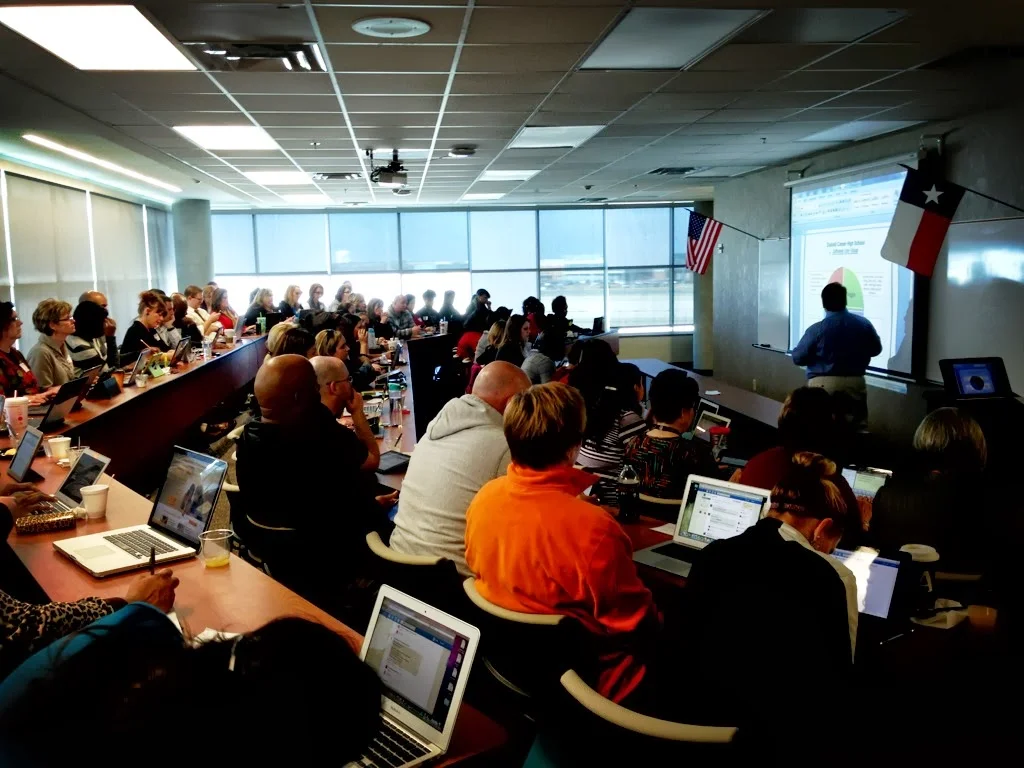
The increasingly competitive global workforce of the 21st century has brought on the need for students and teachers to develop new skills and competencies in our educational systems. Given that the 21st-century classroom is characterized by innovation and project-based context, schools should adopt a 21st-century teaching and learning methods that blend creative thinking skills and employs methods of instruction that integrate modern learning technologies and real-world contexts (Wan & Gut, 2011).

Teacher PD
The increasingly competitive global workforce of the 21st century has brought on the need for students and teachers to develop new skills and competencies in our educational systems. Given that the 21st-century classroom is characterized by innovation and project-based context, schools should adopt a 21st-century teaching and learning methods that blend creative thinking skills and employs methods of instruction that integrate modern learning technologies and real-world contexts (Wan & Gut, 2011). To this end, educators need to be prepared to serve students in the context of new expectations to meet the demands for a more skilled workforce. Accordingly, professional development training for teachers should incorporate innovative curriculum that includes modern technology skills, and practical experiences in a 21st-century classroom environment. This suggests that teachers should also learn about innovative curricula that incorporate critical thinking, complex problem solving, creativity and entrepreneurial thinking, communication and collaboration, innovative use of knowledge, and financial literacy.
How are you personally preparing to address your student’s need to develop 21st-century skills? What is your district’s plan to address these increasing demand for change? At this point, every school system should have educators and administrators actively participating in on-going professional development that focuses on building the capacity of district-level leadership teams, principals, and teacher leaders in understanding 21st-century skills and their importance. According to Wan & Gut (2011), every aspect of our education system including professional development must be aligned to prepare students with the 21st-century skills. Not only should this professional development instruct educators on the 21st-century skills, it should also incorporate modern ideas around technology, innovative pedagogies, and new understandings of the nature of 21st-century students. More specifically, the professional development activities should challenge new and veteran teachers to work within more significant teaching teams and more collaborative professional learning practices (Campbell, Saltmarsh, Chapman, Drew 2013).

ubiquitous technology
Teachers of 21st-century students are increasingly experiencing classrooms where the availability and use of technology by students is ubiquitous. Educational researchers assert,
… it can be argued that there is a need within education for the greater incorporation of technology, a reinvention of the way that classrooms and schools are constructed (at both the physical and relational levels) that respond to the necessary 21st-century skills. The changing nature of technology (moving from static tools for information delivery to dynamic, user developed tools of co-creation and sharing) provides a hint as to what these 21st-century skills may be (Campbell, et.al, 2013, pg. 211).
Along with the integration of technology, 21st-century classrooms are deeply rooted in innovation and problems solving (Chesbro & Boxler 2010). This change in the learning environment for teachers and students creates a need for schools to become responsive and implement new pedagogies to that go beyond the traditional classroom pedagogy (Campbell, et.al, 2013). This is also supported by Wan & Gut (2011),
“For in-service teachers, “just-in-time” preparation that includes coaching and identification of new pedagogical tools and approaches to weave 21st century skills into content areas should be made available. Ideally, teaching academies, or other special initiatives, should exist so teachers can develop and renew 21st century skills and pedagogy in structured programs” (Wan & Gut, 2011, pg. 167).
It is difficult for teachers to teach what they have not experienced or do not know. To this end, the professional development for veteran teachers should intentionally be crafted to ensure the development 21st-century skills in collaborative non-traditional environments to help them understand the needs of the 21st center learner (Wan & Gut, 2011). The closer the professional development environments are to the student learning environments, the more the sharing of practices will lead to the enhancement of student learning (Campbell, et.al, 2013).To summarize, the on-going professional development for veteran teachers should include activities that incorporate innovative uses of technology, pedagogy training that is designed for the 21st-century classroom, and opportunities for teachers to work in collaborative teams of teachers to foster the teacher development of 21st-century skills and competencies.
References
Campbell, M., Saltmarsh, S., Chapman, A., & Drew, C. (2013). Issues of teacher professional learning within ‘non-traditional’ classroom environments. Improving Schools, 16(3), 209-222.
Chesbro, P., & Boxler, N. (2010). WEAVING THE FABRIC of professional development in the 21st century through technology. Journal of Staff Development, 31(1), 48-53,70. Retrieved from http://lib-ezproxy.tamu.edu:2048/login?url=http://search.proquest.com/docview/870739723?accountid=7082
Wan, G. & Gut, D.M. (2011 ) Explorations of Educational Purpose, Bringing Schools into the 21st Century [iBooks Edition]. Retrieved from iTunes.